Unleash Your Inner Inventor with CN LAB's Online Coding & Robotics Courses!
Get ready for the exciting future of technology with CN LAB's engaging online courses in coding and robotics!
Designed for young learners of all experience levels, our courses provide a fun and interactive way to develop essential 21st-century skills like problem-solving, critical thinking, and collaboration.
Welcome to the future robot builders! This eLearning course is your one-stop shop for everything robotics for young minds.
What will you learn?
What robots are: Explore the amazing world of robots and discover how they're used everywhere, from Mars rovers to robot vacuums!
Why robots are cool: Get inspired by the incredible things robots can do and unlock the potential for your own robot creations!
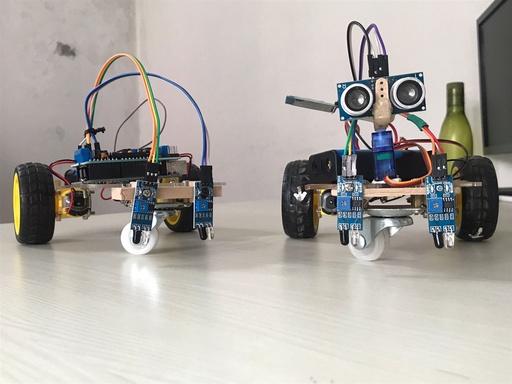
Building your first robot (with Arduino!): Learn the basics of building and programming your very own robot using the user-friendly Arduino platform. It's easier than you think! ️
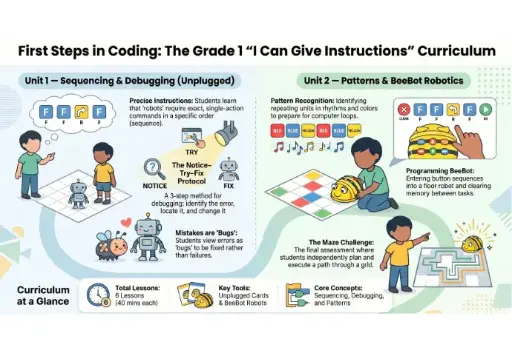
This curriculum pack, titled "I Can Give Instructions," is a comprehensive introductory robotics and computational thinking course designed specifically for Grade 1 students (ages 5–6). Over the course of six 40-minute lessons, students transition from physical, "unplugged" activities to programming a physical robot.
The curriculum is divided into two core units:
Unit 1: Sequencing: Students explore how to provide exact, step-by-step instructions through social and physical activities. They learn to create sequences, understand algorithm basics, and practice debugging using the "Notice–Try–Fix" protocol to find and correct errors.
Unit 2: Patterns & BeeBot: Students learn to identify repeating units in patterns before moving on to hands-on programming with the BeeBot floor robot. The course culminates in a BeeBot maze challenge, where students must independently plan and execute a program to reach a destination.
Key Features of the Curriculum Pack:
Comprehensive Materials: Includes six detailed lesson plans, a student workbook with activity and reflection sheets, a teacher guide with differentiation strategies, and formal assessment rubrics.
Culturally Contextualized: Activities are tailored to the local context in Nepal, using relatable examples such as sequencing the steps to make sel roti or dal bhat, and identifying patterns in Dhaka fabric or Newari window carvings.
Standards Aligned: The curriculum is mapped to the Nepal CDC standards for Maths, Science, and Nepali, as well as international ISTE Competencies for Computational Thinking.
Skill Building: Students develop foundational STEM skills, including spatial reasoning, logical ordering, and verbal justification.
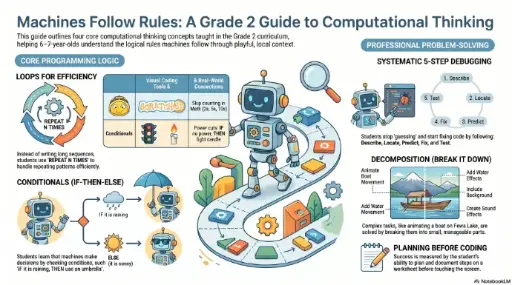
The "Machines Follow Rules" curriculum is a comprehensive 8-lesson computational thinking program designed specifically for 6–7 year olds (Grade 2). Over the course of approximately 5.3 hours (8 lessons x 40 minutes), students transition from physical, "unplugged" activities to digital programming using tools like BeeBot and Scratch Jr.
The curriculum is structured into three core units:
Unit 1: Loops – Students discover how to make instructions more efficient by identifying repeating patterns. They learn to use loop notation (REPEAT N TIMES) first through physical movement and then apply it to program BeeBot robots and create animations in Scratch Jr.
Unit 2: If-Then Rules (Conditionals) – This unit introduces the foundation of machine decision-making. Students explore IF-THEN-ELSE logic through interactive games like "The Traffic Light Game" and by designing "brains" for robots based on real-world Nepal contexts, such as power cuts or water pumps.
Unit 3: Debugging & Decomposition – Students develop advanced problem-solving habits by learning a systematic 5-step debugging process (Describe, Locate, Predict, Fix, and Test). They also learn decomposition, the skill of breaking complex problems—like animating a boat on Pokhara's Fewa Lake—into small, manageable parts.
Key features for an online platform:
Integrated Learning: Connects coding to Grade 2 Mathematics (skip counting), Science (cause and effect), and Language (conditional sentences).
Culturally Relevant: Uses local examples like rice farming cycles and monsoon patterns to make abstract concepts relatable.
Assessment Ready: Includes observation rubrics and student self-assessments to track progress in logic and coding fluency.
The "Machines Follow Rules" curriculum is a comprehensive 8-lesson computational thinking program designed specifically for 6–7 year olds (Grade 2). Over the course of approximately 5.3 hours (8 lessons x 40 minutes), students transition from physical, "unplugged" activities to digital programming using tools like BeeBot and Scratch Jr.
The curriculum is structured into three core units:
Unit 1: Loops – Students discover how to make instructions more efficient by identifying repeating patterns. They learn to use loop notation (REPEAT N TIMES) first through physical movement and then apply it to program BeeBot robots and create animations in Scratch Jr.
Unit 2: If-Then Rules (Conditionals) – This unit introduces the foundation of machine decision-making. Students explore IF-THEN-ELSE logic through interactive games like "The Traffic Light Game" and by designing "brains" for robots based on real-world Nepal contexts, such as power cuts or water pumps.
Unit 3: Debugging & Decomposition – Students develop advanced problem-solving habits by learning a systematic 5-step debugging process (Describe, Locate, Predict, Fix, and Test). They also learn decomposition, the skill of breaking complex problems—like animating a boat on Pokhara's Fewa Lake—into small, manageable parts.
Key features for an online platform:
Integrated Learning: Connects coding to Grade 2 Mathematics (skip counting), Science (cause and effect), and Language (conditional sentences).
Culturally Relevant: Uses local examples like rice farming cycles and monsoon patterns to make abstract concepts relatable.
Assessment Ready: Includes observation rubrics and student self-assessments to track progress in logic and coding fluency.
This curriculum pack, titled "I Can Give Instructions," is a comprehensive introductory robotics and computational thinking course designed specifically for Grade 1 students (ages 5–6). Over the course of six 40-minute lessons, students transition from physical, "unplugged" activities to programming a physical robot.
The curriculum is divided into two core units:
Unit 1: Sequencing: Students explore how to provide exact, step-by-step instructions through social and physical activities. They learn to create sequences, understand algorithm basics, and practice debugging using the "Notice–Try–Fix" protocol to find and correct errors.
Unit 2: Patterns & BeeBot: Students learn to identify repeating units in patterns before moving on to hands-on programming with the BeeBot floor robot. The course culminates in a BeeBot maze challenge, where students must independently plan and execute a program to reach a destination.
Key Features of the Curriculum Pack:
Comprehensive Materials: Includes six detailed lesson plans, a student workbook with activity and reflection sheets, a teacher guide with differentiation strategies, and formal assessment rubrics.
Culturally Contextualized: Activities are tailored to the local context in Nepal, using relatable examples such as sequencing the steps to make sel roti or dal bhat, and identifying patterns in Dhaka fabric or Newari window carvings.
Standards Aligned: The curriculum is mapped to the Nepal CDC standards for Maths, Science, and Nepali, as well as international ISTE Competencies for Computational Thinking.
Skill Building: Students develop foundational STEM skills, including spatial reasoning, logical ordering, and verbal justification.
Welcome to the future robot builders! This eLearning course is your one-stop shop for everything robotics for young minds.
What will you learn?
What robots are: Explore the amazing world of robots and discover how they're used everywhere, from Mars rovers to robot vacuums!
Why robots are cool: Get inspired by the incredible things robots can do and unlock the potential for your own robot creations!
Building your first robot (with Arduino!): Learn the basics of building and programming your very own robot using the user-friendly Arduino platform. It's easier than you think! ️